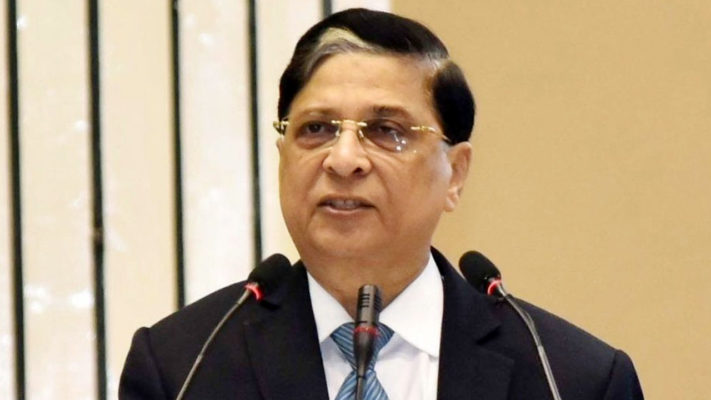
Seven years later, CJI Mishra's landmark verdicts continue to shape Indian law and society in profound ways.
CJI Mishra’s 10 Key Verdicts
- Babri Masjid/Ram Janambhoomi dispute
- Aadhaar validity and constitutional status
- Women’s entry in Sabarimala Temple
- Section 377 and LGBTQ+ rights
- Mosque significance in Islamic law
- Other high-profile corruption cases
- Fundamental rights interpretations
- Constitutional amendments review
- Religious freedom jurisprudence
- Digital privacy and data protection
CJI Mishra Set To Deliver 10 Key Verdicts
Chief Justice of India Deepak Mishra recently recommended the name of his successor: Justice Ranjan Gogoi, who is the senior most justice in the Supreme Court after him. CJI Mishra will retire in almost 19 days, but he has at least ten massive judgements lined up.
CJI Mishra has handled many sensitive and controversial cases during his time in court, including high profile corruption cases and other significant judgements. But the last days of his tenure, which will technically end on October 1, needs him to judge some significant cases like the politically charged Babri Masjid/Ram Janambhoomi, the validity of Aadhar, prohibition of entry of women in the Sabrimala Temple, Section 377, which criminalises homosexuality, and many more. All these judgements have far-reaching consequences on fundamental issues that will define the fate of the citizens of our country.
The outgoing judge has to decide the significance of mosques in Islam. This decision will reflect on the ruling of the Ayodhya case concerning the Babri Masjid-Ram Janambhoomi dispute, which has seen a lot of violence in the past years. Justice Mishra heads a 3-judge bench which will decide in favour of or against the Muslim parties, who demanded a reconsideration of the 1994 M Ismail Farooqui judgement, that states that mosque is not integral to Islam. If the verdict agrees with the Muslim parties, then the case will be given to a larger bench of 7 judges.
The Aadhar card scheme of NDA government has seen a lot of flak since a plea was filed five years ago against its constitutional validity. A five-judge bench had reserved its judgement that challenged the validity of the unique biometric scheme and the law that enables it. Activists see the scheme as flouting the right to privacy, which is now a fundamental right as declared by the Supreme Court.
Keeping in mind the right to privacy and the right to dignity, a group of celebrities filed pleas against article 377. The constitutional bench had reserved verdict on July 17 against the law that criminalises homosexuality.
The issue of entry of women in Sabrimala temple is another one that awaits judgement. A five-judge bench had reserved its order after observing that women of a certain age were prohibited from entering the temple, indicating the “patriarchal” mentality where a man has access to all the spaces and his dominant status in the society makes him superior to women, barring them from being treated equally in places of religion.
The Supreme court has to give a verdict on the case of penal laws on adultery. The constitution bench reserved its order in August; the case questioned the validity of the archaic law which the centre deems necessary for maintaining the “sanctity of marriage”. The bench asked, “what is the collective public good” in section 497 and that the concept of gender neutrality is absent in the section.
Another issue that the top court needs to deliver a verdict on is disqualification of MPs/MLAs in elections if they face criminal charges. The bench reserved its order on the plea, that wants the disqualification before conviction, to curb the criminalisation of politics in India. Attorney General KK Venugopal, speaking for the centre, appreciated the attempt to cleanse the political system, but commented that lawmaking decisions are not under the jurisdiction of the court. The right to file candidates on the party symbol lies with the political parties, and the court cannot deny that right, as stated by AG Venugopal.
The plea by NDA government, reviewing the M. Nagaraj judgment that put restrictions on reservations in promotions, also requires a verdict. The constitution bench will decide if the states have to provide reservation to Scheduled Castes and Scheduled Tribes (SC/ST) during promotions in government jobs.
Advocate Ashvini Kumar Upadhyay had sought to bar lawmakers from practising as advocates and, the top court had reserved the verdict after the centre stated that legislators are not employed full-time by the government but elected representatives.
In April, the court reserved its verdict on the petitions challenging the July 2017 order, which does not allow immediate arrests related to offences flouting the anti-dowry law. The order came after the two-judge bench noted cases of misuse and ordered family welfare committees be set up in districts to look into complaints of dowry harassment.
These are some of the contentious issues that the retiring CJI Mishra needs to give verdicts on, before October 2nd. The key decisions will have far-reaching consequences determining the course of social problems that the country faces.
Frequently Asked Questions
When did CJI Deepak Mishra retire?
CJI Deepak Mishra retired on October 2, 2018, after serving as Chief Justice of India. His tenure saw several landmark verdicts that shaped Indian constitutional law and had far-reaching implications for Indian citizens.
What was CJI Mishra’s verdict on Ayodhya dispute?
CJI Mishra headed a 3-judge bench examining the Babri Masjid-Ram Janambhoomi dispute. The bench had to rule on whether a mosque is integral to Islam, reconsidering the 1994 M Ismail Farooqui judgment that stated mosques are not essential to Islamic faith.
Did CJI Mishra give verdict on Section 377?
Yes, Section 377 decriminalization was among CJI Mishra’s pending verdicts. This landmark case concerned whether homosexuality should remain criminalized in India, with significant implications for LGBTQ+ rights and fundamental freedoms of Indian citizens.
What is the Aadhaar judgment by CJI Mishra?
CJI Mishra’s bench examined the constitutional validity of Aadhaar, the NDA government’s biometric identification scheme. The judgment determined whether Aadhaar violated fundamental privacy rights and whether it could be made mandatory for essential services.
Who succeeded CJI Deepak Mishra after retirement?
Justice Ranjan Gogoi succeeded CJI Mishra as Chief Justice of India. Gogoi was the senior-most justice in the Supreme Court after Mishra and served as CJI from October 3, 2018, to November 17, 2019.
Disclosure: This article may contain affiliate links. VoxSpace may earn a small commission if you make a purchase through these links, at no additional cost to you. This does not influence our editorial opinions or reviews.














Comments are closed.