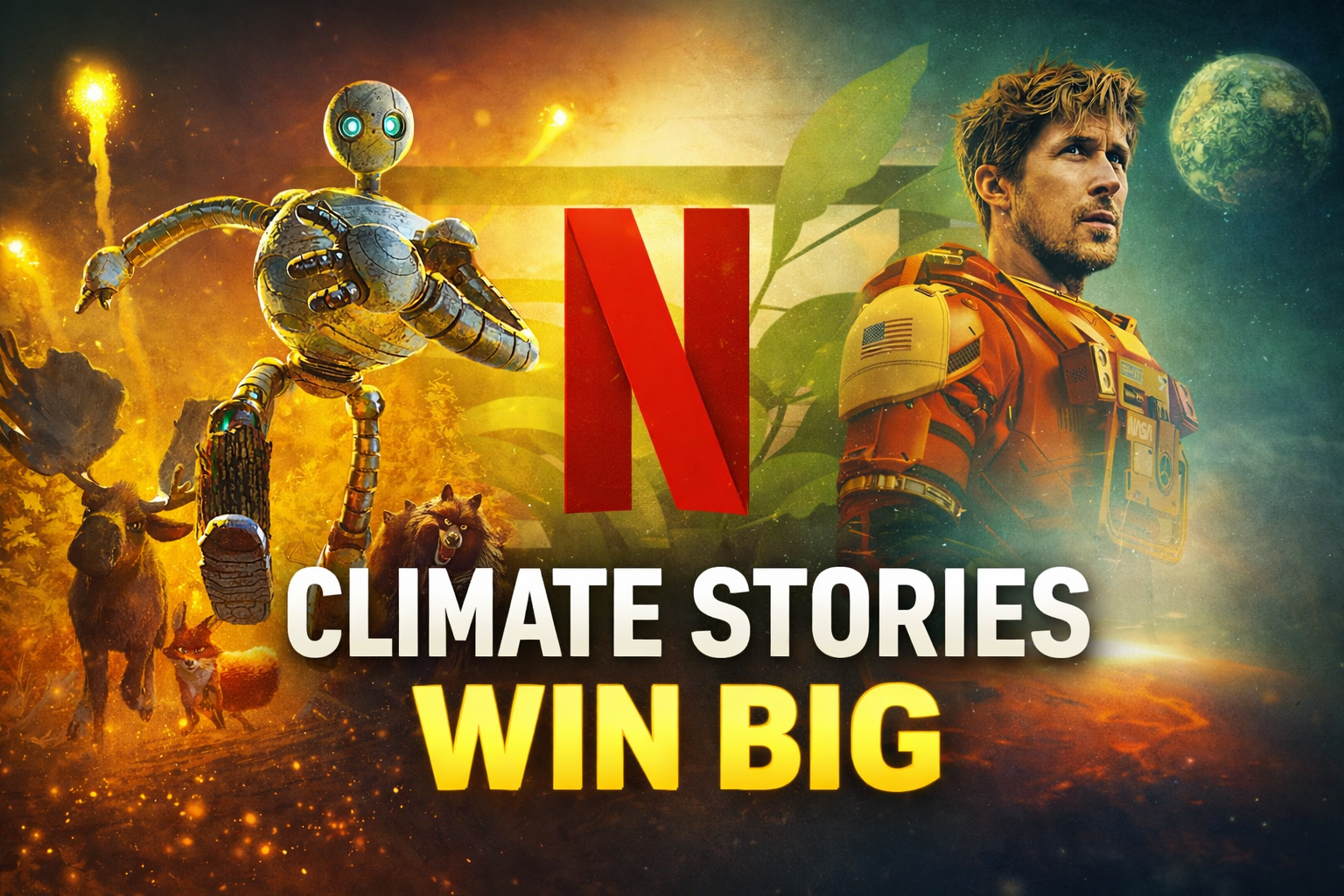
Hollywood discovered climate stories make money
Project Hail Mary opened to $140.9 million globally. Amazon MGM’s biggest launch ever. A film about a teacher stopping a microorganism from consuming the sun shouldn’t work on paper—but it did, becoming 2026’s third-highest-grossing film. The lesson isn’t subtle: audiences will show up for climate stories if you stop treating them like medicine.
What makes Andy Weir’s adaptation click is structural. The disaster—astrophage eating the sun—isn’t the villain. It’s context. The actual story is about ingenuity, resource scarcity, human problem-solving. A teacher with limited supplies in deep space figures things out. Swap “astrophage” for “ocean acidification” and the skeleton holds perfectly. That’s climate storytelling working as propulsion, not sermon.
This isn’t a one-off win. The Wild Robot grossed $334.5 million globally with a submerged Golden Gate Bridge in the background—never announcing itself as environmental cinema, just reflecting ecological collapse as naturally as the sky. Thomas Vinterberg’s series Families Like Ours, about Denmark evacuating due to rising seas, hit 93% on Rotten Tomatoes. The pattern is clear: audiences respond when climate is the setting, not the message.
The money is following the movement
Until recently, climate in film meant two things: documentary guilt or blockbuster spectacle where cities flood and heroes escape. Nuance died in the pitch meeting. But infrastructure is shifting. The UN Climate Change launched the Entertainment and Culture for Climate Action alliance—moving past “green sets” toward using actual storytelling to normalize climate solutions as narrative fact.
India saw the first institutional move in April when Netflix partnered with Pluc.TV to launch the country’s first Climate Scriptwriting Lab. Sixty writers, mentored by industry veterans, learning to weave climate into mainstream genres. Not climate films. Films that happen to contain climate. The ChangeNow initiative runs alongside it, accelerating funding for sustainability-driven media. Film Independent simultaneously created a $25,000 grant specifically for climate fiction features. The money isn’t betting on message—it’s betting on story.
This matters because institutional backing changes what gets made. When Netflix funds it, when the UN coordinates it, when studios greenlight $140M budgets around it, climate storytelling stops being fringe activism. It becomes industry standard. Writers who understand this shift will define the next decade of content.
Why writers need to actually understand climate
Here’s where it gets uncomfortable. You cannot write a believable resource conflict or a community fracturing under ecological stress if your knowledge is Wikipedia-level. Climate reality has texture: policy levers, supply chains, human cost, feedback loops. Surface-level understanding shows instantly to audiences who live with these concerns daily.
Anna Jane Joyner, working with Good Energy, makes this clear: narratives must speak to climate reality, not around it. The difference is enormous. Speaking around it means vague shots of floods and recycling messages. Speaking to it means understanding why a coastal community can’t just leave—economic ties, family history, nowhere else to go. It means knowing that crop failure doesn’t just mean hunger, it means power dynamics shift, that migration becomes coerced, that certain people absorb the cost.
The writers defining this era aren’t writing about climate. They’re writing through it. They absorb the policy, the data, the human specificity. Then they forget all that technical knowledge and focus on making you care about one person. That person’s problem happens to stem from ecological collapse, but you don’t notice the construction. You just care whether they survive Tuesday.
This requires work. Real work. Reading UN frameworks, understanding carbon economics, knowing what “tipping points” actually mean in human terms. The payoff is immediate: scripts that feel true because they are true, characters facing problems grounded in actual systems rather than invented drama.
The shift from incidental to structural
Climate in older films was incidental. A flood scene in a disaster movie. A drought forcing conflict in a western. Background dressing for human drama. The climate was never the point—it was just weather.
Structural climate storytelling is different. The climate IS the pressure that shapes everything else. In Project Hail Mary, you can’t solve the character problem without understanding the astrophysics. In The Wild Robot, the ecosystem collapse creates the orphan protagonist. In Families Like Ours, national evacuation is the plot engine, not decoration.
This shift matters because it normalizes ecological crisis as something writers take seriously. Not as backdrop but as consequence. Characters don’t talk about climate—they navigate it. And audiences, having watched enough climate news to understand that the crisis is real, recognize authenticity instantly. They know the difference between a film that researched and one that guessed.
What this means for Indian storytelling
India sits at the center of climate narrative future. We experience the crisis—heat waves, monsoon failures, agricultural collapse, migration—while global audiences still watch from distance. Indian writers have something advantage: lived texture that international writers must research.
The Netflix Climate Scriptwriting Lab isn’t accident placement. India has 1.4 billion people whose daily lives already contain climate consequences. A writer here knows what water scarcity looks like, what happens to agricultural communities, how power and resources shift. That specificity is gold for storytelling.
But there’s risk too. Climate storytelling can become poverty tourism—white savior narratives where external help solves local problems, or where communities are portrayed as passive victims. Indian writers have the responsibility to reject that frame. Stories should center Indian problem-solving, Indian ingenuity, Indian resistance. Not as charity narrative but as human survival narrative.
The writers who understand this—who grasp both climate science and power dynamics, who write Indian characters as agents rather than subjects—will dominate global screens. The scriptwriting lab is the infrastructure. The storytelling is the weapon.
The uncomfortable truth about craft
Climate narratives demand a different skill set than traditional storytelling. You can’t fake it. Audiences living with ecological crisis daily will spot false notes instantly. If your character makes a decision that ignores actual resource constraints, they’ll know. If your plot resolves without addressing systemic problems, they’ll feel the dodge.
This means writers need to become researchers. Not superficially. Actually understand carbon cycles, policy mechanisms, economic incentives, power structures. Read the IPCC reports. Understand what “1.5 degrees” means in practical terms. Know why certain communities can’t adapt even when they want to. Understand that climate crisis isn’t equally distributed—it’s weaponized along existing inequality.
Then forget all of it and write characters. Specific people with specific problems shaped by systemic pressures. The technical knowledge becomes scaffolding, invisible to audience but essential to authenticity.
The writers who skip the research phase will write scripts that feel shallow. The writers who do the work, then trust the story rather than the information, will write the films we remember. There’s no shortcut. The second-best time to understand the world you’re writing about is now.
Frequently asked questions
Is climate storytelling just environmental propaganda?
No. The successful climate films—Project Hail Mary, The Wild Robot—don’t lecture about environmentalism. They tell human stories where ecological pressures shape conflict and survival. The climate is context, not message.
Can climate stories appeal to mainstream audiences?
Project Hail Mary‘s $140.9M opening proves yes. Audiences don’t reject climate narratives; they reject preachy ones. When climate creates genuine stakes for characters people care about, it works commercially.
Why is the Netflix Climate Scriptwriting Lab important for India specifically?
India experiences climate consequences daily while having massive storytelling talent. The lab creates infrastructure for that lived experience to become global narrative, shifting the center of climate storytelling from Western perspectives to Indian ones.
Do writers need scientific degrees to write climate fiction?
No, but you need to research seriously. Read frameworks, talk to experts, understand the policy and human systems at stake. The research becomes invisible in the final script, but without it, the authenticity fails.
Are there grants available for climate fiction projects?
Yes. Film Independent offers $25,000 grants for climate-focused fiction features, and the ChangeNow initiative funds sustainability-driven media. Netflix’s Climate Scriptwriting Lab offers mentorship and development deals in India.
You Might Also Like
- [VoxSpace Life] Greta Thunberg : The Young Crusader Professing For A Better Tomorrow
- Before The Flood Is Leonardo DiCaprio's Sincere Attempt To Save Environment
- Why Indian Screenwriters are Too Cynical to write good Rom-Coms anymore
- [VoxSpace Selects] Top Screenwriting Lessons Every Storyteller Needs To Know
- [VoxSpace Selects] Top Screenwriting Lessons Every Storyteller Needs To Know Part Two
- Vara : The First Telugu Short Film On Multiverses Attains A Cerebral Bliss
- [VoxSpace Selects] Understanding Telugu Lyrics 101 - What They Actually Mean