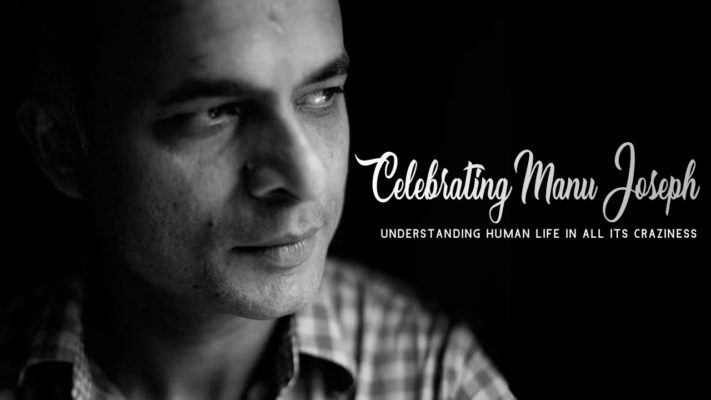
Nearly a decade later, Manu Joseph's literary innovations continue to captivate Indian readers discovering his profound narratives for the first time.
My First Tryst With The Literature Of Manu Joseph
Falling prey to the attention-economy that plagues our generation, I had almost given up my hopes of reading any book in 2018. After the gloomy September rains paved the way to some chilly cold coffee nights, I found one book that I picked up at a book fair, because I thought the cover was intriguing. ‘The Illicit Happiness of Other People‘ by Manu Joseph. Even within my circle, I had heard people talk of it, recommend it and review it. And I suppose this book was my charm to getting back into reading. I had indeed been Manu Joseph’ed. (Yes, I turned his name to a verb, because that’s how smitten I am by his writing).
If you’re anything like me, once you like an author’s work, you collect, read, obsess over everything that they have ever written. And so after my first experience, there lied two more books on my shelf, neatly arranged with the rest of their proud lineage.
If you haven’t read Indian authors much and do not appreciate the monotony that you presume lies in Indian Writing, Manu Joseph’s books are your go to. He will change your world view of Indian Writing, one page at a time. Joseph is a journalist turned author. And his writing is reflective of his knowledge and experience. The language of Manu Joseph is his USP – it is irreverent and deliberately shocking. Only he can describe a building to be ‘pus coloured’, and introduce characters with their body odours!
The Story Of Manu Joseph And The Art Of Being A Bird
Manu Joseph was born in Kerala, as you may have guessed by now from some of the settings in his books. He grew up in Chennai, where he graduated from Loyola College, and then dropped out of Madras Christian College. He started his career as the staff writer at Society magazine, then became the editor of OPEN magazine. He was the columnist for The International New York Times and The Hindustan Times. He was also Chevening Scholar in 2007. The PEN jury described him as “…that rare bird who can wildly entertain the reader as forcefully as he moves them.” And I cannot disagree.
‘The Illicit Happiness of Other People’ brings us to discover the true purpose of psychiatrists and their subjects. In ‘Miss Laila’, we see intelligence officers and sting operations struggle through. In ‘Serious Men’, he explores the thick of office politics!
His writing can be observably fast-paced, with long-staying characters. He makes sharp observations and strong opinions in the subtlest of humour that you can’t help but laugh and nod at the same time. Very few authors can write chuckle-worthy content, especially in fiction. Manu Joseph’s natural sense of humour shines through each of his work. In one of his interviews, he says ever-so-pleasantly,
(sic) I think almost everybody is mad. I really believe that. Very few people in the world are sane, one of the subjects of my next book. You look at the average person—his or her beliefs, the huge cathedrals built for them, the religions that maintain order, the rubbish that people believe in, the imbeciles who can influence millions, the rover on Mars searching for water—it is very obvious to me that most people are actually mad. Sanity is a gift. In fact, Acharya is less insane than most people who think he is. Deep within him there is a clarity of thought. Sanity is about that—clarity. The struggle of humanity to achieve clarity is what all art is about.
Analysing ‘Serious Men’ From The Lens Of Manu Joseph
Manu Joseph’s first book, Serious Men won The Hindu Literary Prize in 2010 and the PEN Open Book Award in 2011. It was also shortlisted in 2010 for Man Asian Literary Prize.
“..he tried to look at her face in the hope that she was not pretty. Beautiful women depressed him. They were like Mercedes, BlackBerry phones and sea-view homes.”― Ayyan Mani in Serious Men
Serious Men is a beautifully written satire on the journey of two very starkly different people whose lives are bound together, Aravind Acharya and his personal secretary, Ayyan Mani. As Ayyan goes through his day, he makes observations, judges their superficial knowledge and hates them so much so to poke fun at them every opportunity he gets. It also stems from the aspiration that he wishes to be like them for he thinks that he can escape that mundaneness that life is, only if he’s that certifiably smart.
“The fate of every love story, he knew very well, is in the rot of togetherness, or in the misery of separation. Lovers often choose the first with the same illusory wisdom that makes people choose to die later than now.” – Aravind Acharya in Serious Men
The potent tragedy in this book so undercut that it is humorous in some places and thought-provoking at others. Each character is built with special intentions and transcending goals that dramatise every interaction with certainty and vicissitude – something we all wish we had.
“Happiness as an inescapable fate, not a pursuit.”― Unni Chacko in The Illicit Happiness of Other People
The Illicit Happiness Of Other People…
On the other hand, his book, ‘The Illicit Happiness of Other People’, explores the beauty of hopelessness in a land where there’s only hope and happiness. From the indecipherable Unni Chacko to the endearing Thoma Chacko, his little brother, to Ousep Chacko, the menacing drunkard, who probes the reasons for his son’s extreme act, the twists and turns are unpredictable.
“He stares at the open textbook for hours and is distracted by the pain of the parallelogram, which is slanted forever. His nails scratch the page to straighten its tired limbs. It affects him, the great arrogance of the Equilateral Triangle, the failed aspiration of the octagon to be a circle, the eternal suffocation of the denominator that has to bear the weight of the unjust numerator, the loneliness of Pluto. And the smallness of Mercury, always a mere dot next to a yellow sun. In this world, there is no respect for Mercury.”― About Thoma Chacko in The Illicit Happiness Of Other People
The critical factor that worked for this book was the authenticity and rationality with which each plot element is handled. Nothing is over-done, no character is overplayed. It is hard writing dark comedy, in itself and with this book Manu Joseph exceptionally excels at not just dark comedy, but also making sly shifts from comedy and tragedy, making a reader go through a roller coaster of emotions in each page.
Manu Joseph Explores Themes Of Subjective Humanisation…
Miss Laila – Armed and Dangerous on the other hand – that is sure to give you a confusing ride of Manu’s writing for the first 50-60 pages, and before you know it you are done with the book. And then, you realise the subservient trick that was played on you. Laila Raza, the main protagonist, is the biggest mystery of the entire book.
“..As it usually happens to a discreetly pursued car, the blue hatchback begins to assume bleak human qualities. It looks stupid, debased and tragic, its haste comical because it is only racing towards a carefully laid-out trap. A little blue car duped by the republic, a young intelligence officer on its tail. How did these fools get into this situation when life is actually somewhat beautiful, and easy too, no matter what writers say?”– Jamal in Miss Laila, Armed and Dangerous
Although this book ranks lower in terms of wit and humour, against his other works, I particularly enjoyed the fact that Laila was shown only through her hopes, thoughts and actions as perceived by the narrator. Her character bears the colours of her description, and none of them is really her. This was the stalwart trick Manu Joseph decided to play on his readers where you feel you know Laila, except you don’t, you didn’t.
“Laila says poor people, like them, should learn to love science because science is more equal and fair than arts. Aisha understands. The thing about science is that if you are smart no one can say you are not smart.”
And like him, as he is and his opinions, his writing is unapologetic, direct and crisp. He makes sure guilt is equally distributed, and you don’t really know with which side his real sympathy lies.
To the Hindu in an interview, he once said “When opportunity grows, everything changes and for a writer, it becomes a true reflection. Fiction is neither an academic’s analysis nor an exaggeration. Sometimes reality is crazier,”
If you haven’t yet, grab a copy of his book and lose yourself in a ride of bemusing and comical reality.
Frequently Asked Questions
Who is Manu Joseph and what books has he written?
Manu Joseph is an Indian author and journalist whose literary works include ‘The Illicit Happiness of Other People,’ ‘Serious Men,’ and ‘The Illusion of the East.’ His background in journalism deeply influences his storytelling, blending journalistic precision with literary depth and irreverent social commentary.
What makes Manu Joseph’s writing style unique and distinctive?
Joseph’s USP lies in his irreverent and deliberately shocking language that challenges conventional Indian writing norms. His ability to describe mundane elements with vivid, unconventional imagery—like describing a building as ‘pus coloured’—sets him apart from mainstream Indian authors.
Is ‘The Illicit Happiness of Other People’ suitable for first-time readers of Indian literature?
Yes, absolutely. If you haven’t explored Indian authors extensively, this novel serves as an excellent introduction to contemporary Indian writing. It challenges preconceived notions about monotony in Indian literature and offers genuine, human-centric storytelling that resonates with modern readers.
What is the main theme explored in Manu Joseph’s novels?
Joseph’s works explore deeply human themes through complex, flawed characters. His novels examine societal pressures, personal struggles, and the contradictions within human relationships, all narrated with poignant moments interspersed with shocking descriptions and dark humor.
Where can Indian readers find and purchase Manu Joseph’s books?
Manu Joseph’s books are widely available at Indian bookstores, book fairs, and online retailers including Amazon.in, Flipkart, and other digital platforms. His works have been translated into multiple languages and are increasingly available in both physical and digital formats across India.
Disclosure: This article may contain affiliate links. VoxSpace may earn a small commission if you make a purchase through these links, at no additional cost to you. This does not influence our editorial opinions or reviews.











Comments are closed.