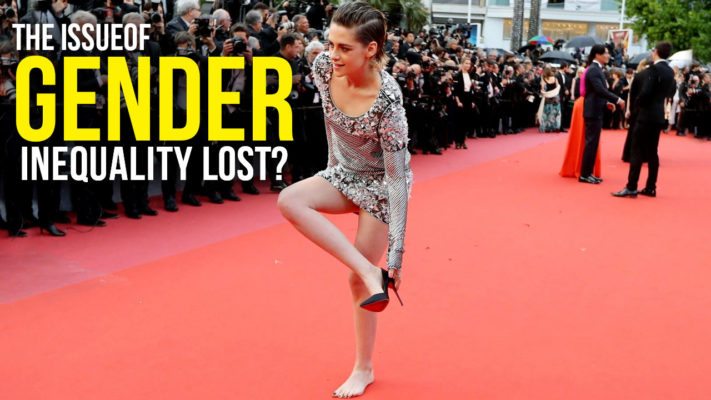
Seven years later, the gender disparity Cannes exposed remains a pressing concern for Indian and global cinema alike.
Key Takeaway
The Cannes 2018 protest by 82 female directors against gender inequality in cinema was not merely a symbolic gesture—it represented decades of systemic oppression in Hollywood and serves as a mirror for Indian cinema to examine its own representation and opportunities for women filmmakers.
The Unscathed Hullaballoo At Cannes
What happened in Cannes Film Festival 2018, has been gathering impetus since decades in Hollywood. If I might ask why Cannes has a colossal impact on the society, it has gathered huge furore over the years owing to Palme d’Or, an honour that has bestowed critical and commercial success on many films in the past. “Marche du Film” has been placed on a pedestal of grave seriousness over the seven decades and is not just a night of starry sightings but a sacred revelry of films and producers. Cannes has played a commendable role in premiering some of the world’s most critically acclaimed films that have mirrored dominant ideologies steeped in society, blatantly exposing the myths and symbols impinging on the creation of an equal society.

This year what grabbed media attention, apart from stars parading in stone studded, gleaming outfits, was a starry gathering of known countenances in cinema, like Kristen Stewart, Patty Jenkins, Cate Blanchett and Salma Hayek. Decoding the total number of women who took part in this dissent is also a matter of significance. 82 is representative of the number of female directors who were given the space to ascend the stairs draped in red in 1946, minor in comparison to the 1,688 male directors, who were privileged enough to share the same space.
Hollywood As The Epicentre Of Bigotry And Sexism
What has not altered in Hollywood is the downright sexist culture that is astonishingly prevalent in one of the most influential domains of movie-making, one that has produced from its bag Pulp Fiction, Deadpool, and Taxi Driver to name a few. Pay gap, sexual exploitation, overt sexual innuendos, and serving the voyeuristic pleasure of audiences are the burning issues. Many a time such brazen acts have been conveyed by media, bringing a perfect storm within the calm of the dining rooms, making headlines in tabloids or evening newspapers and subsiding eventually. What happened in Cannes is the cumulative effort of women coming to the forefront, making a statement, and voicing their concerns. However, there is still a lot of riot in the making till every studio, actor, director is forced to address the long-dwindling issue of gender inequality in mainstream Hollywood.
Amidst all the hustle-bustle in Cannes, which has become the talk of the town mainly because of the paparazzi and star-studded spectacle, the demonstration is nothing short of the darkest hour before the dawn. Cannes made it explicit that women oppression is not restricted to any single class, profession, colour or race, it is pervasive and clutches the white as well as the black. Honestly, I have not witnessed any major coverage of the event by news pages that fervently offered elucidation on fashion and drapery flaunted by Bollywood faces. It would be truly unfortunate if such news is draped in finery and dispatched to the audiences as just another component of starry gaiety.
Is Media Transmitting It Wrong?
Commercialization of these events and protests are not uncommon in the trajectory of film and media. Such demonstrations, events and acts of raising a voice against downright preposterous acts of subjugation have been turned into a controversy, a tool for engagement of readers, political gains, or a pseudo-intellectual topic for a casual evening talk show. As a reader, I have felt the direct subversion of these events, over-exploitation by the media, making them lose significance by either butchering it with language of publicity. So the one question that pops out in readers’ mind is, should these events then be detached from their backdrop and viewed in their quintessential self? If these events are failing to stir the commixture of wrong and baseness still in abundance, then we probably have taken the wrong direction.
https://www.youtube.com/watch?v=fN5HV79_8B8
When I was in University, Oprah Winfrey turned towards a startled and numbed audience present at the Golden Globes Awards to make a powerful speech on misogyny, racism, abuse which wealth and stature can hardly keep at bay. Social media platforms were then populated with a number of interpretations stating the hidden, implicit purpose behind the speech and somewhat the novelty of her speech became lost in the way. This can jeopardize the power of narrative in a public platform where the truth will become a pliant tool for politics. It snatches away the importance of the person who tries to place herself/himself as the voice blowing the trumpet to welcome the wind of change.
The Anecdote
Cannes is a symbol of independence, over the last seven decades it has played an embracing host to many controversial films, lesser-known cerebral films, blockbusters and has made itself known for its valour and audacity. Tossing off a historically symbolic protest that Cannes witnessed would be symptomatic of willful ignorance and oblivion, and pre-designed suppression of voices that aspire to magnify the hushed talks of oppression and bias.
Frequently Asked Questions
What was the Cannes 2018 gender inequality protest about?
In 2018, 82 female directors walked the red carpet at Cannes to protest the underrepresentation of women filmmakers. Since 1946, only 82 female directors had climbed the festival’s iconic stairs compared to 1,688 male directors, highlighting a stark gender disparity in cinema.
Why is the Cannes protest relevant to Indian cinema?
The protest exposes systemic sexism in the film industry globally. Indian cinema faces similar challenges with limited opportunities for female directors and storytellers, making the Cannes movement a mirror for introspection and policy changes in Bollywood and regional film industries.
Which prominent actresses participated in the Cannes 2018 gender protest?
Kristen Stewart, Cate Blanchett, Salma Hayek, and Patty Jenkins were among the notable figures who joined the protest. Their involvement lent significant media visibility and credibility to the cause of gender equality in filmmaking.
What does Palme d’Or represent at Cannes Film Festival?
The Palme d’Or is Cannes’ highest award, symbolizing critical and commercial excellence in cinema. Its prestige makes Cannes a platform where films addressing social issues gain international recognition and influence global film culture and narratives.
Has the gender gap in cinema improved since the Cannes 2018 protest?
While awareness has increased, progress remains slow. Many festivals and studios have implemented diversity initiatives, but systemic barriers persist in financing, distribution, and representation of female directors in both Hollywood and Indian cinema industries.
Disclosure: This article may contain affiliate links. VoxSpace may earn a small commission if you make a purchase through these links, at no additional cost to you. This does not influence our editorial opinions or reviews.
You Might Also Like
- [VoxSpace Selects] u2018We Are What We Eatu2019: Celebrating Food In Cannes
- [VoxSpace Life] Patriarchy Is Bad For All Genders And Guess What - It's Ruining Our Men Too
- [VoxSpace Selects] The #KuToo Movement And Japanu2019s Sexist Laws In Corporate Workplaces
- [VoxSpace Selects] Five Books That You Should Read If You Want A Crash Course On Feminism
- [VoxSpace Life] Oxfam Report : Analyses Of The Global Wealth Distribution Disparity
- [VoxSpace Life] Scuttling of Gender Justice - The JNU Administration Style
- [VoxSpace Life] Why The Acceptance Of ALL Genders Is Required In India








Comments are closed.