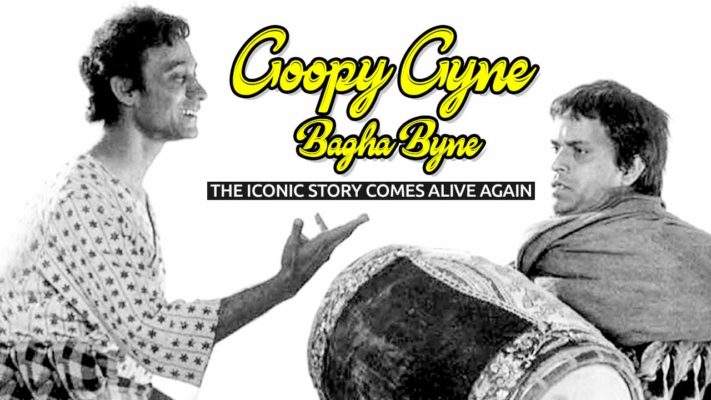
Five decades later, Goopy-Bagha's blend of fantasy and social commentary continues to captivate Indian film enthusiasts rediscovering Ray's masterpiece.
Paying Homage To The Fantasy Fiction And Political Satire
Joychandi Pahar, tucked away in Purulia, West Bengal is an undulating land with scattered hills, and Satyajit Ray’s plateau de torunage for Goopy Gyne Bagha Byne (1969), a film dipped in the dreamy elements of magical realism and fantasy fiction. Today as the Bengali speaking duo Goopy-Bagha turns 50, fans cannot help but rummage Goopy-Bagha’s exuberant perambulates, magical escapades and the privileges of a flâneur’ s lifestyle that Ray gifted us half a century ago. Goopy-Bagha, two social outcasts and improvised artists, played by Tapen Chatterjee and Rabi Ghosh respectively, would be later translated into regional and major international languages, bagging two national and four international awards.
Bengal was at its peak of Naxal uprising, armed students’ movement, and mass activism when Goopy-Bagha’s enigma spread through the shabby lanes of Bengal. Their chemistry was an instant hit within the urban and rural audiences, Ray captured audiences’ imagination with an quirky amalgamation of the fantastic, political and uncanny. Odd because, it was unprecedented in Bengal still recuperating from the massive Naxal violence that burnt every quarter of the city and shook every political institution from its foundation.
https://youtu.be/QCTdQdEUDhM
Goopy, Bagha, two austere characters draped in dhoti and shawl, drawn by Upendrakishore Ray Chowdhury, were rooted into the stark realities of their ordinary lives. Unlike the celebrated heroes of our land, they miserably failed at inheriting any real talent for art; the two prodigal village boys had little to offer the society and later went on to bag whopping international recognition, stretching beyond the fictional Shundi, and the Bengal theatre screens. In an age of political censorship on art, culture, and media, Goopy and Bagha remain emblematic of liberty, the freedom to be. It is not just a celebration of this iconic duo, the spokesperson of democracy and common people, but also an artist’s vision untainted by political clampdown. We have indeed come a long way since then, late 20th century Bengal, of keeping theatres free of party propaganda and blatant deification. Ray’s Goopy Gyne Bagha Byne had aesthetics so unwaveringly blended within the socio-political conditions of its time, this fantasy tale remains largely pertinent and peculiar to Ray’s oeuvres.
Ray As The Music Composer
Goopy Gyne Bagha Byne, Hirak Rajar Deshe, and Goopy Bagha Phire Elo complete the heroic deeds of the duo and a journey so replete with cinematic marvels pleated within the desolation of Bengal’s rural areas. Ray himself has written the lyrics of the trilogy, a volume overflowing with right-wing politics; the verses are lengthy harangues on dictatorship and war. They give us a glimpse into the banal and beautiful of Goopy-Bagha’s time. The bulk in itself is considered to be a vast literature strung together by the maverick. Ray’s symphony pulsates through each scene, echoing the universality of the emotions that this trilogy aspired to generate.
https://youtu.be/QALojkAg2Ko
Ray’s Humanitarian Outlook For Characterization
Goopy and Bagha are kept dangling amidst an array of characters that add to the political dimension of this trilogy. Goopy-Bagha are far from being apolitical and the amount of adulation the trilogy has enjoyed can be partly attributed to Ray’s strain of fierce politics. Any understanding of the duo would remain incomplete without taking into equation King of Shundi, Borfi, Professor Udayan and other minor characters. Such characters could be vividly brought into life back then without any political ferocity, unexplained ban on screening, or burn of effigies. There is no daunting presence of “star personae” in this trilogy; and even though Goopy-Bagha were born out of tolerant times, viewers were not allowed to indulge into self-alienation coming to the theatres just for the sake of star worshipping!
50 Years Of A World Of Hems And Haws
Set at the heart of contradictions, the trilogy has its own set of political connotations. From anticipating the failure of state mechanisms to laughing at the king’s pitiful lack of better judgement, this hodgepodge needs continuous interference of magic to heal. In Hirak Rajar Deshe, we see the blissful anesthesia into which the kingdom has descended. Such morbid representation of a king’s desire to reign supreme at the cost of people’s welfare reflects on today’s limited scope of research, curb on campus politics, and freethinking that are heavily truncated due to the overwhelming prevalence of state censorship.
If the first film of the trilogy drops us in a deplorable world of wars and ammunition, Hirak Rajar Deshe is hallucinatory, producing the effect of a world glistening from afar forever receding beyond the stretch of your palm. Ray’s magic realism is not without its degree of hilarity, and contemporary political stances further heightened by eloquent use of language. It is also a world with an immense amount of hope, amounting to a complete overthrow of a dictatorial regime. Ray’s exploration of cinematic techniques for Goopy-Bagha trilogy, hitherto unexplored in Bengali cinema, remains unparalleled in the annals of time.
https://youtu.be/9H_lX2FRhxw
Let Not The Politics Subside In Goopy-Bagha!
Contrary to popular opinions, the world of Goopy-Bagha is far from being utopian one, it is perhaps the same contradiction that Aldous Huxley imposed on readers with Brave New World. Shundi is ruled by Goopy-Bagha, once outcasts and now invested in leading a globetrotter’s lives better than their kingly duties. They have managed to bargain two princesses, royal borne, in exchange for their magic. But how exactly Goopy and Bagha have managed to do their conjugal duties looms in dark. One ponders whether the administration of Shundi should be controlled by two lenient kings with their heads in the clouds? Probabilities of dissent manifest itself in multitude, however, owing to the lack of sequels, fans can only speculate about the fate of Goopy-Bagha!
Ray has always maintained to show the rift between science and society (especially an agrarian one) where its usages can be subverted to send its subjects into a perpetual state of happy forgetfulness, numbing all their senses to dictatorship and loot. The lingering effects of scientific experiments like “brainwash” is almost like a tranquilizer, deadening the feelings of doubt, dissent, and knowledge, and producing an infantile state of happiness and innocence. The metamorphosis from monarchy to democracy remains perennial; in this land of magic there is no ultimate salvation, no redemption from mortal blemishes; Goopy and Bagha might appear as a silver lining, if not humankind’s Good Shepherd.
Frequently Asked Questions
When was Goopy Gyne Bagha Byne released?
Satyajit Ray’s Goopy Gyne Bagha Byne was released in 1969, making it a landmark film in Bengali cinema. The film premiered at international festivals and became a beloved classic that continues to enchant audiences across generations.
Who played Goopy and Bagha in the original film?
Tapen Chatterjee and Rabi Ghosh played the titular characters Goopy and Bagha respectively. Their chemistry and performances brought Ray’s whimsical characters to life, creating an unforgettable cinematic experience for Indian audiences.
Is Goopy Bagha based on a book by Upendrakishore Ray Chowdhury?
Yes, Goopy-Bagha originated from stories written and illustrated by Upendrakishore Ray Chowdhury, Satyajit Ray’s grandfather. The characters were later adapted into this celebrated 1969 film, blending fantasy with social realism in Ray’s distinctive style.
What awards did Goopy Gyne Bagha Byne win?
The film bagged two National Awards and four international awards, establishing itself as a critically acclaimed work. Its recognition reflected Ray’s innovative approach to fantasy cinema and the universal appeal of the characters within Indian and global film festivals.
Why is Goopy Bagha important to Bengali cinema?
Goopy-Bagha represents a unique moment in Bengali cinema where fantasy, political satire, and social commentary converged during India’s turbulent 1960s. The film’s cultural impact established Ray’s influence on Indian popular culture and influenced filmmakers across regional cinema.
Disclosure: This article may contain affiliate links. VoxSpace may earn a small commission if you make a purchase through these links, at no additional cost to you. This does not influence our editorial opinions or reviews.
You Might Also Like
- [VoxSpaxe Selects] Satyajit Rayu2019s Calcutta Trilogy And The Socio-Economic Pathos Of Bengali Urban Middle Class
- [VoxSpace Selects] Sambhavtaha : A Heart-Wrenching Tale Of A Farmer's Plight
- [VoxSpace Selects] Wong Kar-Wai : Cinema Never Happened Academically, It Grew Within Him
- [VoxSpace Selects] Stan & Ollie: A Peek Behind The Curtain Into The Latter Years Of Laurel & Hardy
- [VoxSpace Selects] Lakshmi : This Progressive Tale Of A Woman Is As Relishing As A Bharathiyar Poem
- [VoxSpace Life] KIFF 2018 : Bengalu2019s Tryst With World Cinema And It's Cherish For The Bygones
- [VoxSpace Selects] Remembering Rituparno Ghosh : The Pioneer Of Bengali Experimental Cinema