The Rise Of Mr Bharat – Manoj Kumar
Time to take out the time machine and go somewhere back in 1956, just a few days before the Republic day and our story starts here.
Lekhraj Bhakri, who was a filmmaker, had come to Delhi for the premiere of his movie “Tangewali,” starring the son of the theatre and movie legend Prithviraj Kapoor, the one and only Shamsher Raj “Shammi” Kapoor. There he met one of his relatives, a man who had witnessed the horrors of partition after migrating to the nation’s capital from Jandyala Sher Khan (a village in Punjab, now in Pakistan) and staying in the refugee camps that were established in the outskirts of Delhi for almost two years.
Lekhraj upon meeting this man remarked, “You look just like a film hero,” to which the reply came, “Make me a hero!” And after two months this young man decided he would follow up on his Bollywood dreams and landed himself in Bombay. That’s how the journey of Hari Krishen Goswami or Manoj Kumar or Mr Bharat started and the rest, as they say, is history.
Manoj Kumar’s tryst with patriotism started from his first outing in the silver screen itself, the role was of a mendicant in the 1957 movie “Fashion,” where he was given to sing ‘Maati ko lajaana nahin mera desh hai mahaan;’ however, his stardom actually came in 1965 with three super hit movies – Himalay Ki God Mein, Gumnaam and Shaheed. The last one was based on the life of Bhagat Singh and it won a National Film Award for Best Hindi Feature Film. The songs of that movie are heard even to this day during Independence Day functions, year after year. “Ai Vatan Ai Vatan Hamko Teri Kasam,” “Sarfaroshi ki Tamanna,” “Watan Pe Marne Wale Zinda Rahega Tera Naam” and “O Mera Rang De Basanti Chola” were instant hits and, as time passed by, became classics. “Shaheed” also marked an important juncture in Manoj Kumar’s life – Lal Bahadur Shastri, who was the Prime Minister back then asked him if the actor could make a film on his slogan “Jai Jawaan Jai Kisaan” and the result was a movie called “Upkar.”
It was not only a massive hit but also got Manoj Kumar another national award. The name of his character in this movie stuck with him forever – “I had named my hero Ram, as he was an ideal son. But since he was a farmer, and the real India lives in the villages, I renamed him Bharat.”
The brand stuck and with his subsequent outings, such as “Purab Aur Pacchim” and “Roti Kapada Aur Makaan,” the identity was sealed and Manoj Kumar became Mr Bharat.
The Advent Of Akshay Kumar For The Common Masses
Like life, movies, trends and themes also come to a full circle and now, as the time passes by, after the era of bell bottoms, jumping jacks, dancing around trees, the angry young men, the slap-stick comedy era; we reach 2007 and as I remarked, everything comes to a full circle, we are back to a scene from “Purab Aur Pacchim,” where one man mouths lines to foreigners reminding them why India will always be a class apart and on a repeat telecast, the audience roars into agreement – “Namaste London” and Akshay Kumar.
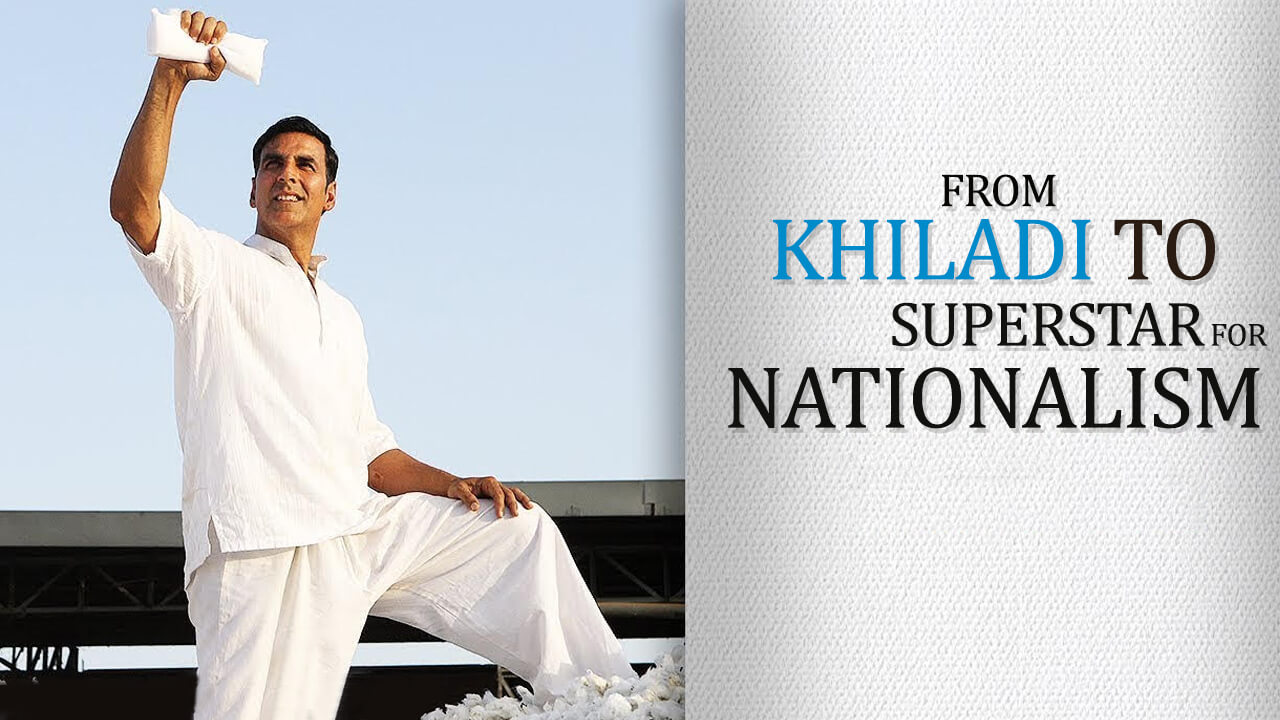
This also starts the journey of Rajiv Hari Om Bhatia aka (Khiladi) Akshay Kumar slowly veering his gaze into a theme that has been used sparingly by filmmakers these days, the age-old formula of patriotism. Akshay Kumar’s shift to becoming that actor that can bring the millennial generation back in the theatres using nationalism as a platform was a slow and well-calculated step. In 2014, “Holiday — A Soldier Is Never Off Duty,” he teamed with South’s A.R. Murugadoss, who had already delivered a hit in Bollywood with “Ghajini,” to bring forward how soldiers fight valiantly every day and save the country against terrorists.
This theme was again repeated with a much sleeker avatar in “Baby,” which released the very next year and had Akshay Kumar up the ante as a covert officer, who will never get credit for what he has done for the country. The very same year “Gabbar Is Back” was released, where he took on corrupt politicians. If one expects that the audience would get tired of it, it’s a mistake because there are more than one ways to fry the fish and Akshay Kumar now sets his eyes on the expat community. Previously all they had was either Karan Johar’s grandiose dramas or the feeling of separation, thanks to indie movies, but now they have a movie called “Airlift,” where Kumar shows that no matter what happens India will always be there to rescue them out of trouble, after all once an Indian always an Indian. Then came “Toilet: Ek Prem Katha,” which echoed with the present PM Narendra Modi’s agenda just like what “Upkar” did with Shashtri’s.
The Nationalism Packaging Done Right…
Akshay Kumar doesn’t sell movies in just packages of nationalism. He knows that there should be a presentation to go along with it otherwise the youth would not buy the tickets. So there are item songs in these movies, “Dil cheez tuje de di” in “Airlift” and “Kundi mat khadkao raja” in “Gabbar is Back” and similar things in others. There is a message involved plugged in with contributions he makes for the Indian Army and every step is carefully planned because Khiladi Kumar knows that he has found success in a way that will shatter into pieces if a small rock is thrown at it.
Therefore, you don’t see any mention of the jeans fashion walk where he didn’t do anything wrong but was lampooned by social media trolls (his wife opened a button of his denim pants) or any scandals that seem to be a staple of every actor’s life. Even, his endorsements are kept clean and the patriotic image is cashed in on.
Is there something under the rag? Maybe several skeletons or maybe none but maybe there is a little bit of hypocrisy involved. Have you heard of the documentary called the “Menstrual Man,” which was made in 2014 or “The Pad Piper” in 2013? What about “Phullu,” which came out in 2017? Well, all of these movies were made on Arunachalam Muruganantham, the man who devised how to produce low-cost sanitary pads and led a hygiene revolution in rural India. However, chances are you have heard of “Padman,” Kumar’s latest movie, which stars Radhika Apte and Sonam Kapoor. All these years, several media coverage, so many interviews and a significant amount of documentaries about Arunachalam Muruganantham and here we are!
In India, armchair appreciation has also come a long way and for Akshay “Bharat” Kumar? Well, at least in the department of making the moolah on nationalism, as the “Padman” tagline goes “Superhero hai yeh Pagla!”