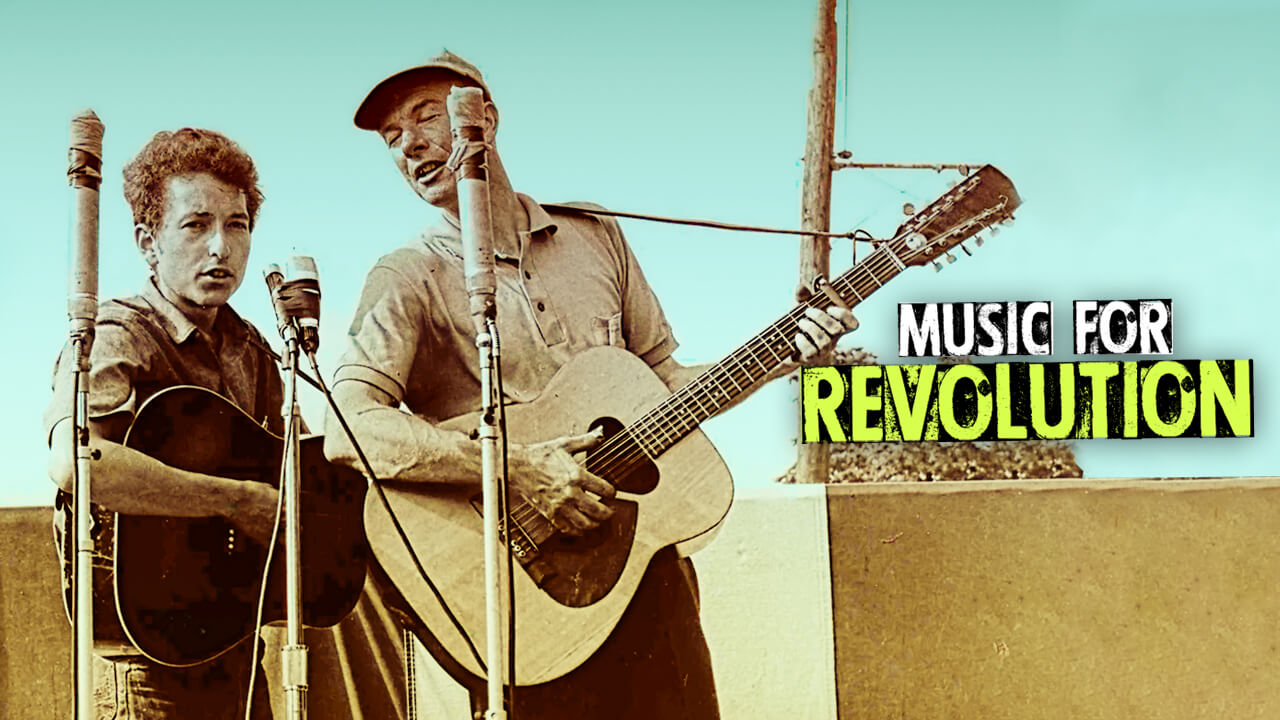
Decades later, the legacy of these musical revolutionaries continues to inspire activists and artists across India fighting for social justice through art.
Of Music, And Revolution: Two Musicians Who Evoked Change
The word music has different connotations for different people. While it gives some people a sense of hope during times of despair, it can motivate and inspire others to start a revolution.
The story in question talks about two musicians; Pete Seeger, who fought for peace and justice in America, and Sixto Rodriguez, the man who paved the way for musicians to fight apartheid in South Africa.
Pete Seeger – Music For Justice And Change
Born in 1919, Pete Seeger was exposed to music at a young age and spent his life dedicated to the ‘power of song’. At 19, Seeger met Woody Guthrie, a man who advocated social justice for the working class.
Pete learned the importance of fighting for justice through his music and proved that it could also bring about tangible change in society.
In 1955, Pete Seeger took a popular folk song titled ‘Where Have All The Flowers Gone’ and added a verse or two. The song is a timeless classic about war and peace.
“Where have all the soldiers gone
Long time passing?
Where have all the soldiers gone
They’ve gone to graveyards every one
When will they ever learn?”
Seeger was a living testament to the First Amendment of the United States’ Constitution, resonating the freedom of speech and expression.
He played a vital role in bringing music to the Civil Rights Movement in the US. Seeger performed ‘We Shall Overcome’ at a Folk music festival in Jr. Martin Luther King’s presence. King was taken aback by the power of the music and soon Seeger helped incorporate it into their organizing tactics.
Pete Seeger was the epitome of music that believed in social justice and equal rights. In a documentary called ‘The Power of Song’, Seeger explains how music has the power to unite people and bring change. “Participation, that’s what will save mankind,” he said.
Seeger was never appreciated for his relentless fight for peace. Instead, he was titled ‘anti-American’ for singing songs about bringing soldiers home from war. But as time passed, people came to realize what he did was never out of hatred, but out of love.
The Power Of Song – A Documentary:
Sixto Rodriguez – The Inner City Poet
It was the early 1970s when Sixto Rodriguez walked the streets of Detroit in the United States, with a guitar strapped to his back. A silent spectator of the hardships faced by people in the troubled city during the ’70s, Rodriguez had a hidden talent that most people in his home country were unaware of.
Rodriguez was a moving musician and was dubbed an inner city poet. He recorded two albums; Cold Fact (1970) and Coming from Reality (1971). Unfortunately, the albums were monumental flops in the US. But as they say, ‘one man’s trash is another man’s treasure’.
The music managed to find its way to South Africa in the ’70s. The story of how the album landed in the then authoritarian country varies a lot. The most common story was of an American woman, who travelled to South Africa to meet her boyfriend and played the vinyl record of Cold Fact, mesmerizing people around her. Since the record was unavailable in South Africa to purchase, locals taped copies of the album.
The album began to spread like wildfire in South Africa where everything was censored at the height of apartheid. Rodriguez’s music evoked a sense of revolution in people’s hearts and he became a rebel icon. His music became the soundtrack to the South African people’s lives.
https://youtu.be/8oNs9yuB3-o
South Africans learned the term ‘anti-establishment’ from the musician. In the album Cold Fact, Rodriguez recorded a song elaborately called, ‘This is Not a Song. It’s an Outburst: Or, The Establishment Blues’.
“Garbage ain’t collected, women ain’t protected
Politicians using, people they’re abusing
The mafia’s getting bigger, like pollution in the river
And you tell me that this where it’s at.”
“Opened the window to listen to the news
But all I heard was the Establishment’s Blues.”
Rodriguez’s lyrics showed the people that it was alright to be angry at injustice and protest for one’s rights. Speaking about Cold Fact, music journalist Craig Bartholomew said, “This album somehow had in it, lyrics that almost set us free as oppressed people.”
Any revolution needs an anthem and Cold Fact epitomized the feeling in South Africa. Several musicians gathered under the banner of the ‘Voelvry Movement’, to sing against the government.
Most of these musicians were heavily influenced by Rodriguez and one band adopted the movement’s name.
‘Voelvry’, which means outcast or free as a bird, summarized the message they wanted to spread. One of their hit songs was Set It Off. The song targeted then-President PW Botha and asked the people to switch off their television as he pointed his finger at everyone else, but himself.
This was one of the earliest forms of opposition against apartheid that came from within the Afrikaans community. Years later, during Nelson Mandela’s tenure as President, people got inquisitive and began looking for the musician who changed their lives.
Finally, they found him living a modest life in Detroit and asked him to come to South Africa. Thousands of people waited as Rodriguez walked onto a stage after two decades, to perform for people who idolized him.
His first words to the crowd were, “Thanks for keeping me alive,” before the music took over.
Frequently Asked Questions
Who was Pete Seeger and what did he fight for?
Pete Seeger (1919-2014) was an American folk musician and social activist who championed civil rights, labor rights, and peace through music. He performed ‘We Shall Overcome’ during the Civil Rights Movement and collaborated with Woody Guthrie to create socially conscious music that inspired generations.
What is the meaning of ‘Where Have All The Flowers Gone’ by Pete Seeger?
‘Where Have All The Flowers Gone’ is an anti-war protest song addressing the consequences of military conflict. Seeger added verses to this folk classic to highlight how soldiers are lost to graveyards, creating a powerful meditation on peace and the human cost of war.
Who is Sixto Rodriguez and how did he fight apartheid?
Sixto Rodriguez was an American folk musician who became an unlikely symbol of resistance against apartheid in South Africa. Though unknown in America, his music resonated deeply with South African activists, helping to fuel the anti-apartheid movement through powerful, socially conscious songwriting.
How did music become a weapon for social change?
Musicians like Seeger and Rodriguez proved music transcends entertainment—it mobilizes communities, preserves collective memory, and inspires action during oppression. Their songs created spaces for marginalized voices, unified movements, and challenged injustice when traditional platforms were unavailable to activists.
What is the relevance of protest music in today’s social movements?
Protest music remains vital in 2025, with artists globally using their platform to address inequality, climate change, and human rights. The legacy of Seeger and Rodriguez demonstrates that music’s power to inspire revolution is timeless, continuing to shape activism across generations and continents.
Disclosure: This article may contain affiliate links. VoxSpace may earn a small commission if you make a purchase through these links, at no additional cost to you. This does not influence our editorial opinions or reviews.
You Might Also Like
- Musical collective Indian Jam Project gives a classical touch to popular theme songs.
- [VoxSpace Health] Music And Its Use For Inspiring Social Change And Healing
- If Sherlock Holmes Was Made In India, This Is How His Theme Music Would Sound Like!
- Malavika And Sri Krishna Reprise 'Andala O Chilaka' And It's Simply Soothing!!
- [VoxSpace Selects] Understanding Telugu Lyrics 101 - What They Actually Mean
- VoxTalks With Sooraj Santhosh : Co-Founder Of 'Masala Coffee' And A Versatile Independent Singer
- This 18 Yr Old's Renditions Of Various Hits Is Bound To Take The Internet By Storm..!












Comments are closed.