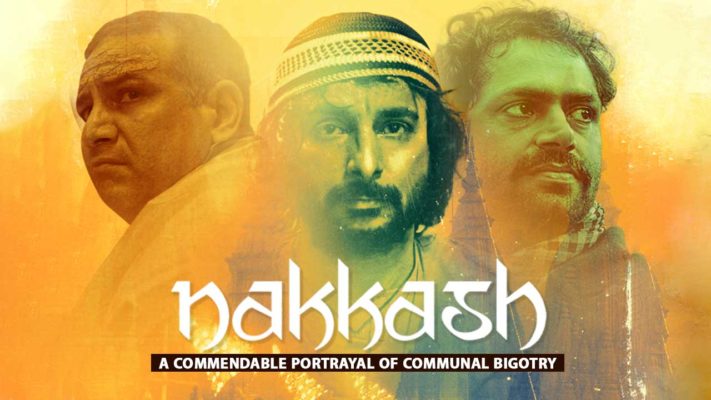
Even years after its release, Nakkash remains a vital critique of how communal divisions threaten India's secular fabric and individual identity.
VoxSpace Verdict
Nakkash is a courageous cinematic statement that refuses to sanitize the rising tide of communal antagonism. While it brilliantly captures the atmosphere of bigotry pervading the nation, the film leaves viewers with uncomfortable questions about identity, faith, and belonging that demand continued societal introspection. A necessary watch for those seeking cinema with conscience.
A Brave Statement At The Face Of Turbulent Times
It is saying a lot about the kind of world we are living in when basic decency and interactions make news for something extraordinary keeping the outrageous human atrocities within the parameters of normalcy. Allah Miyan, short name for Allah Rakha Siddiqui is the protagonist of the recent Zaigham Imam film, ‘Nakkash’. Allah Miyan finds exposure in the hands of the prying tactics of the media while he is shunned by his community and treated with distrust by the Hindu community for his devotion and commitment towards a craft that has been his family legacy.
The word ‘Nakkash’ suggests engraver or sculptor and the film derives its title’s significance from the “nakkashi” craft that Allah Miyan practices in the temples of Varanasi. His father handed down the skill work of “nakkashi” to Allah Miyan when he was a child. Allah Miyan’s knowledge of trade skills, begins and ends at “nakkashi” and it is the only trade on which he roots his son’s life. As a matter of fact, he is that single father, an exceptional hero whose challenges in love, commitment and parenting are as same as the conventional mother.
As the rise in the Hindutva politics mold the extreme antagonism of the majority community and the disparagement of the minority community towards him, Allah Miyan realizes that the world around him is changing and not for the good. However, throughout the ups and downs of his life, he had kept his faith unbroken in humanity because of two primary factors. First would be Bhagwan Das Vedanti, the temple priest with secular values who has always believed in him and stood with him against the Hindu dogmatists disapproving of any Muslim existence within a holy place of the Hindus. Second would be Samad, his best friend who has always liberally supported him and stood for him within the Muslim community.
Not A Clichéd Sermon But Extremely Relevant
It does not need to be pointed out that Nakkash is extremely relevant and contextual to the present times with communal hatred and enmity being relentlessly promoted by the right-wing institutions nationwide. Although, it might look like Nakkash would go for the traditional sermonizing approach, fortunately it does not and simply sticks to its guns of narrating a story that is relevant and relatable. Zaigham Imam explores the rampant hate politics of the nation as a contrast to the innocence of Allah Miyan who is very clearly a misfit in the contemporary Indian social and political scenario.
To state an instance, when Vedanti says to a police officer, “While eating food, do you check to find out whether the grain came from a Hindu or a Muslim farmer?” he faces up to an ideological traditionalist with fundamentalist inclinations and in the process animates arguments one can hear across the nation today.
Last year, ‘Mulk’ by Anubhav Sinha became one of the few Bollywod films that could muster up the courage and the voice to talk about the distressed relationship between the country’s Hindus and the Muslims in a time of hyper Hindutva nationalism. Sinha made a frank commentary in exposing the Islamophobia that has been internalized within the country’s corners and he did so without ghettoizing the Muslim community, something that Bollywood would have done even a few years ago. Nakkash offers an even more detailed view into these complexities and goes into depths exposing the negatives of both the communities not caring whether it is good, bad or ugly.
Dramatics, Narration And Techniques
Director Zaigham Imam’s film, ‘Alif’, which was released in 2017, explored on somewhat similar planes of the communal politics between Hindus and Muslims. In comparison, Nakkash is more dramatically evolved and demonstrates strength on all fronts including storytelling and techniques. Sumit Mishra’s art design and Asit Biswas’s cinematography brings out the inherent contrast between the communal hostility of the country and the innocence of Allah Miyan. With respect to the style of the narration, Imam approaches the film’s story line with tones that occasionally move from naturalism to an operatic one. The plot does not employ any instance of extremely thrilling twists to overwhelm the audience. Instead, it follows a lifelike saga in a natural setting with toxic relationships that becomes convincingly relatable.
However, one major downside of this rather progressive content is the marginal existence of a female standpoint on the significant issues presented within the film. There is very little action in the film involving except may be a couple of women characters. Such a drawback becomes extremely prominent in a film that presents bigotry as its central issue. Other than that, a few instances here and there such as that overtly stretched closing montage and the lack of finesse in the performances of some of the supporting casts add up to be minor setbacks in the film.
Hitting The Right Notes Of Performance Art
Inaamulhaq in the character of Allah Miyan delivers a brilliant job. A toned performance and hesitant demeanor assists Inaamulhaq to naturally slip into the simple character of Allah Miyan. The audience can relate to his experiences and empathizes with his fate as he moves through his life and its complexities. His relationships, be it with the priest, his son or his best friend, are all sketched from a three-dimensional perspective providing it with the vividness it deserves. Sharaib Hasmi as Samad, meets with the expectations of a dazzling performance. He provides a convincing performance and offers a realistic perception of his character. Kumud Mishra as Bhagwan Das Vedanti, the temple priest, delivers a dignified performance with a high note of stoicism that he so successfully renders to his character.
Nakkash presents only the tip of the iceberg. Although it manages to brilliantly build up the atmosphere of communal bigotry across the country, it leaves behind a heap of politically driven distrust and discord that yet needs to be explored. Reality checks in when a politician claims, “Rajneeti karam se nahi, dharam se hoti hai (Politics is not done by duty but by religion)” and just like that you realize that it is ever relevant. Nakkash pulls at the right strings at the right times.
Frequently Asked Questions
What is the film Nakkash about?
Nakkash follows Allah Miyan, a Muslim craftsman practicing the traditional nakkashi (engraving) art in Varanasi’s temples. The film explores how rising communal tensions affect his life, faith, and relationship with both his own community and the majority Hindu society, presenting a story of resilience amid bigotry.
Who directed Nakkash and when was it released?
Nakkash is directed by Zaigham Imam. The film emerged as an important indie cinema statement examining communal divisions in contemporary India, offering a nuanced perspective on minority experiences through the lens of artistic tradition and personal survival.
Is Nakkash available on OTT platforms in India?
While primarily a festival circuit and limited theatrical release film, Nakkash has found audiences through various indie cinema platforms and streaming services in India. Check your preferred OTT platform’s indie cinema or documentary sections for availability and regional accessibility options.
What is nakkashi craft and why is it important in the film?
Nakkashi is the traditional art of temple engraving and sculpting passed down through generations. In the film, it represents cultural heritage, identity, and the bridge between communities. Allah Miyan’s mastery of this craft becomes both his livelihood and his struggle in a polarizing society.
Why should Indian audiences watch Nakkash in 2025?
Nakkash remains profoundly relevant as it addresses ongoing questions about communal harmony, minority rights, and cultural preservation in India. Its unflinching portrayal of bigotry and human decency offers viewers a mirror to examine their own society and the importance of protecting secular values and artistic freedom.
Disclosure: This article may contain affiliate links. VoxSpace may earn a small commission if you make a purchase through these links, at no additional cost to you. This does not influence our editorial opinions or reviews.
You Might Also Like
- Remembering Gauri Lankesh : The One Who Spoke Truth To Power
- [VoxSpace Life] Hinduism Vs Hindutva : An Understanding Of A Religious Militant Outfit
- Communal Violence In Bihar - A Systematic Effort To Disturb The Social Fabric Of The Society
- Review Of Bhonsle: A Politically Ambitious Cautionary Tale
- [VoxSpace Selects] Review Of Netflix's Cinema Bandi: An Acutely Well Observed Tribute To Cinema
- [VoxSpace Selects] Game Of Thrones S8EP3 Spoiler Review : The Battle For Winterfell
- [VoxSpace Selects] Review Of 'Hey Bhagwan!' : Adaptation Of Is God A Taoist Walks On A Tricky Road




Comments are closed.