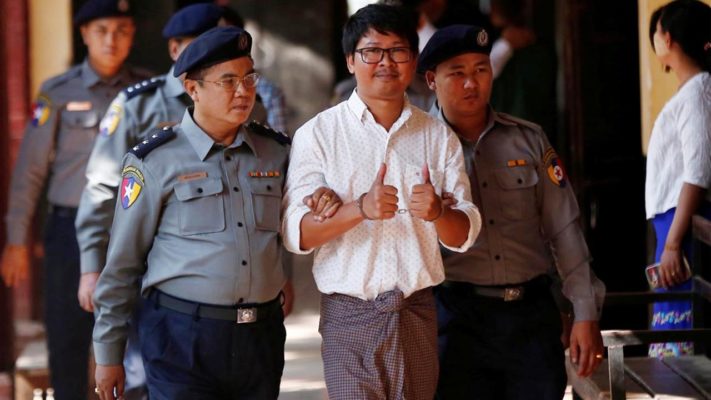
This 2018 landmark case remains a critical reference point in discussions about press freedom and journalistic integrity in Southeast Asia.
The Verdict
Sentence: 7 years imprisonment
Charge: Breaching Myanmar’s Official Secrets Act of 1923
Case: Coverage of Rohingya crisis and alleged army violence in Rakhine village
Implication: Major setback for press freedom and international journalism standards in Myanmar
Reuters Journalists Arrested For Breaching The Official Secrets Act Of Myanmar
Myanmar is in news and not for the right reasons, again. Two Reuters journalists, namely Wa Lone and Kyaw Soe Oo have been sentenced to seven years in prison, for breaching the Official Secrets Act in regard to covering the Rohingya issue in the country. The world has been looking on to the verdict of this landmark case, which gives out many implications on how conscious the government is about the test of democracy in Myanmar. The journalist pair were originally arrested in last December under this act introduced by the British in 1923 and has been in custody for the last nine months without even a chance to see their family.
Myanmar government and their de facto leader Aung San Suu Kyi were not holding up a good image for the last many months because of the ongoing Rohingya issues there. More than 700,000 Rohingya Muslims, an ethnical minority in Myanmar, were forced to flee the country and Suu Kyi had been trying to defend this “ethnical cleansing”, as described by the UN. Both Lone and Soe Oo had been working on this issue, collecting evidence about the murder of 10 Rohingya men by the army in Rakhine village. Stories about the army violence in this village have been condemned by international media and human rights organizations. Many have been reported to be murdered, assaulted, raped, enslaved and persecuted.
Both the journalists were kept in Yangon’s Insein Prison, the colonial-era architecture to lock up political prisoners where ironically Aung San Suu Kyi herself was jailed for a brief period.
Judge Ye Lwin, while reading out the verdict, said the pair “did not behave like ‘normal’ journalists.” They have been charged with intentionally giving out information to the enemies of the nation. The journalists have been reported saying that the documents were handed over to them by a policeman and were arrested by a different set of police officials at the same spot. A police witness has testified this restaurant meeting was a set-up trap to arrest them.
The two journalists pleaded not guilty and commented that they are not surprised by the verdict. “What I want to say to the government is: you can put us in jail, but do not close the eyes and ears of the people,” said Kyaw.

Reuters editor-in-chief clarified that they stand by the reporters and the investigation. Commenting on the court verdict, he termed it as a “major step backwards” for the country.
The UN Human Rights Chief Michelle Bachelet called for the immediate and unconditional release of the two men. The court ruling has drawn condemn from many other human rights organizations, international media, governments, civil societies in Myanmar and social media. Myanmar government spokesperson or any other officials have refused to comment upon the incident.
Frequently Asked Questions
Who are Wa Lone and Kyaw Soe Oo?
Wa Lone and Kyaw Soe Oo are Reuters journalists arrested in December 2017 while investigating the killing of 10 Rohingya men by Myanmar’s military in Rakhine village. They were investigating alleged army violence during the Rohingya crisis.
Why were the Reuters journalists sentenced in Myanmar?
They were convicted under Myanmar’s Official Secrets Act of 1923, a colonial-era law, for possessing classified military documents related to their Rohingya coverage. The charges were widely criticized by international media organizations and human rights groups.
What is the Rohingya crisis in Myanmar?
Over 700,000 Rohingya Muslims, an ethnic minority in Myanmar, were forced to flee the country. The UN described the military’s actions as ethnic cleansing, involving murder, assault, rape, and persecution of the vulnerable Rohingya population.
How long were Wa Lone and Kyaw Soe Oo in custody?
The journalists spent nine months in custody at Yangon’s Insein Prison before their sentencing. They were not allowed to see their families during this entire period, raising concerns about fair trial procedures and human rights violations.
What did Aung San Suu Kyi say about the Rohingya crisis?
Myanmar’s de facto leader Aung San Suu Kyi defended the military’s actions despite international condemnation. Her stance on the Rohingya crisis damaged Myanmar’s international image and drew criticism from human rights organizations worldwide.
Disclosure: This article may contain affiliate links. VoxSpace may earn a small commission if you make a purchase through these links, at no additional cost to you. This does not influence our editorial opinions or reviews.
You Might Also Like
- The Borderlands : Border Stories Beyond Military And Diplomatic Relationships
- [VoxSpace Life] NRC And Political Appeasementu00a0In Assam : The Question Of Survival In A Lost Land
- [VoxSpace Selects] India And Its Dwindling Relationship With Free Press
- An Open Letter To TV9 : Congratulations On Your Decency In The Death Of India's Biggest Female Superstar
- [VoxSpace Life] The Aadhar Question: Why The Aadhar Card Linking Mandate Isnu2019t Appropriate
- The Nagaland Floods : As The State Reels Under Catastrophe It Remains Neglected Even Now
- Sri Reddy Protests Naked But Of Course There Is No Such Thing As Casting Couch, Isn't It?




Comments are closed.