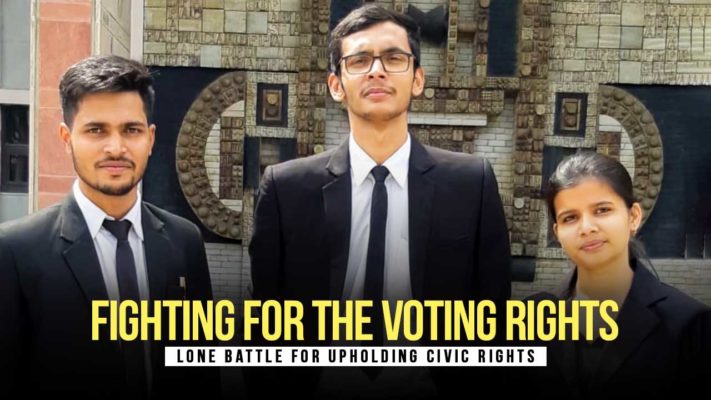
Six years on, this landmark PIL continues to shape conversations around prisoner disenfranchisement and constitutional rights in India.
If Criminals Can Contest, Should Prisoners Be Enabled To Vote?
With the National Elections coming in less than a couple of weeks, we have someone who’s fighting for human rights of 4 hundred thousand prisoners who are now currently serving their sentence in Indian jails.
Praveen Chaudhary, Atul Kumar Dubey, Prerna Singh, fourth-year law students from Galgotias University have filed a Public Interest Litigation(PIL) challenging Section 62(5) of Representation of People Act which has a blanket ban on anyone “confined in a prison or in the lawful custody of the police” to vote at any election.
Their petition reads, “Any denial of prisoners voting right is inequity and inequality or discrimination invites the wrath of the Constitution. Such a thought is abominable, for it slaughters the core identity of their nationhood.”
After drafting for more than a month, they filed the petition on February 21. The first hearing was held on March 8 where the Delhi High Court asked the respondents to reply within three weeks. The next hearing is scheduled on May 9.
Criminal’s Vote For Criminal’s Elections?
Surprisingly those who have criminal charges pressed against them can actually contest in the elections but prisoners cannot vote. It’s ironic how 83% of candidates contesting in the coming elections have criminal charges pressed on them. Before anything, should they be given an opportunity to contest? It’s true that judging someone based on the charges against them is not completely fair. Few may have rivals who are against their good deeds but 83% is not a small figure. It’s almost all of them.
Which means, more or less, criminals are going to decide the laws of the nation in the coming 5 years. Yes, scary! Whether they are going to be convicted or not is still unknown for a lot of those cases are under trial but to have such charges against them is a sign of how far are we from having leaders who are actually righteous and honest to get elected, to run the office or at least contest. Now, for this to change it takes a lot of effort from a lot of institutions and people. Let’s keep it for another article.
Coming back to the point, It’s highly appreciative of how young law students who are out there challenging few constitutional obligations. But is it the right place to start? Should the prisoners (mostly criminals) be given a chance to vote(for other criminals)? This was the first doubt I got when I came across the news. Like I mentioned before, criminals are going to be the lawmakers and here these students are fighting for human rights and a chance to give prisoners a chance to vote in the elections. How weird!
A Solid Perspective To Back The Petition
In an interview with VICE, when asked about why ‘voting for prisoners’, they gave a really different perspective. When prisoners have the right to vote, representatives will go to them to seek support which will provoke them to look into the dismal condition of prisons in our country. Also how many resources are our police stations and central jails lacking will be brought under the light. Isn’t it the responsibility of the leaders to take care of these things too? This makes absolute sense.
They have also mentioned that they are not particularly inclined towards anyone or have any personal interest in the cause. Today its prisoners and tomorrow it could be someone else and that it’s pure public interest. Another point mentioned by these students grabbed my attention. Chaudary mentions that “The prisoners will realize that they too are citizens whose opinions matter and that they too can decide their own political leader.”
Not every prisoner is going to be given a life sentence. That means they are going to join the civilians and their communities once they are done with their sentence in jail. Giving them a right to vote, will make them realize that their presence is acknowledged. Aren’t prisons a place for rehabilitation? Making the prisoners feel accountable and responsible is important and giving a right to vote may do that job.
Risk Is Everywhere
I can’t deny the fact that this may also have a counter effect. Prisoners may not have the awareness of what is happening outside the jail and there is a high chance of getting persuaded to do something they don’t want to do under prison politics or may also be victims of propaganda. This proposition has both pros and cons but it’s a good sign that it has started some discussion. A relevant one, to be honest.
Let us know what you think about it in the comments. Is this reform necessary? How will this help the country? Mention your opinions and use the platform for healthy discussions for it’s also our responsibility to be part of such important reforms.
Keeping the heat of the elections and petitions aside, it’s heart-warming to see young students taking such steps using their eligibility and opportunity to make a difference. More power to such students who are fighting for human rights and a better nation!
Quick note: Elections are almost here and we have a really REALLY big task at hands which demands to be responsible. Hence, start working on knowing your constituency and leaders contesting for the elections and research enough to choose the right candidate!
Frequently Asked Questions
Can prisoners vote in Indian elections?
Currently, Section 62(5) of the Representation of People Act imposes a blanket ban on prisoners from voting. However, the 2019 PIL filed by Galgotias University law students challenges this provision, arguing it violates constitutional rights and democratic principles for incarcerated individuals.
What is Section 62(5) of the Representation of People Act?
Section 62(5) is the legal provision that disqualifies anyone “confined in a prison or in lawful custody of police” from exercising their voting rights during elections. This rule has remained contentious as it affects approximately 400,000 prisoners serving sentences in Indian jails.
Who filed the PIL against prisoner voting ban?
Four fourth-year law students from Galgotias University—Praveen Chaudhary, Atul Kumar Dubey, Prerna Singh, and another colleague—filed the Public Interest Litigation in February 2019. They challenged the constitutional validity of denying prisoners their voting rights.
Why can criminals contest elections but prisoners cannot vote?
This paradox highlights an inconsistency in Indian electoral law. While candidates with criminal charges can contest elections, imprisoned individuals lose voting rights entirely. The petitioners argue this contradiction undermines democratic principles and constitutional equality.
What arguments did the law students present in their PIL?
The petition argues that denying prisoners voting rights constitutes inequity, inequality, and discrimination under the Constitution. The students contended that such blanket denial “slaughters the core identity of their nationhood” and invites constitutional scrutiny for violating fundamental democratic rights.
Disclosure: This article may contain affiliate links. VoxSpace may earn a small commission if you make a purchase through these links, at no additional cost to you. This does not influence our editorial opinions or reviews.
You Might Also Like
- [VoxSpace Life] Remembering The Holocaust - Part One (1939-1945) : The Jews Of Auschwitz
- Two Reuters Journalists Jailed In Myanmar For Covering The Rohingya Issue
- [VoxSpace Selects] Taiwan : First In Asia To Legalize Same-Sex Marriage
- [VoxSpace Selects] Music As A Weapon Of Peace : Musicians Who Sparked A Revolution
- u201cLadka Huya Hai Ya Ladki?u201d u2013 Breaking Away From The Binaries Of Sex And Gender With Daniel Mendonca
- [VoxSpace Life] Former Sex-Worker Defies All Preconceived Notions To Stake Her Claim To Motherhood
- [VoxSpace Life] Why The Acceptance Of ALL Genders Is Required In India















Comments are closed.